Lighter, not faster
I keep hearing variants of this complaint lately:
“This (tool / workflow / service / slot machine) is slower than me doing it manually.
Therefore, it's not worth using.”
These people are missing the point. Speed is easy to measure - that’s great. But focusing on speed overlooks the importance of subjective effort and mental load.
Let's talk about grocery stores, naval signaling flags, and the value beyond time saved.
The grocery store self-checkout
In the grocery store, do you choose a human cashier or the self-checkout machine?
People who prefer self-checkout often believe that it's faster. But in my highly-scientific study (loitering in the soup aisle with a stopwatch, n=24), the fastest self-checkout user was only equal in speed to the average cashier in scanning items. Once you add in the time to bag items and pay (not to mention "unexpected item in bagging area"), most people have no chance to outpace a human cashier.
The true value of the self-checkout is to offload social effort, the weight of interaction. Arthur Schopenhauer lived too early to scan his own groceries, but he did write, "A man can be himself only so long as he is alone... for it is only when he is alone that he is really free."
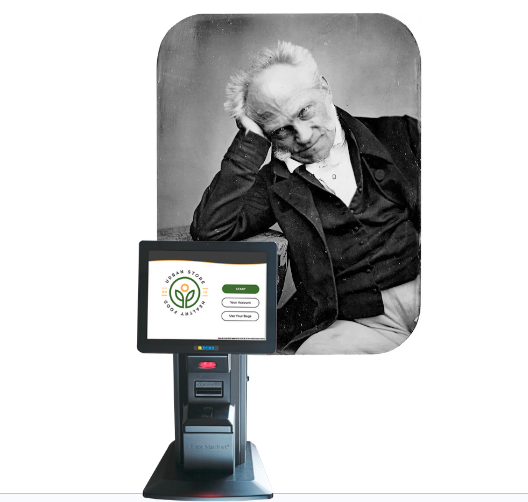
Artist’s depiction
Decoding naval signaling flags (semaphore)
Quick, what is this sailor saying to you?

Image via Wikimedia Commons
It's flag semaphore for the letter "U", of course. One weekend, I was tired of staring at the lookup table for flag semaphore (a common cipher used in puzzle hunts), so I made an interactive graphical tool to help me decode it.
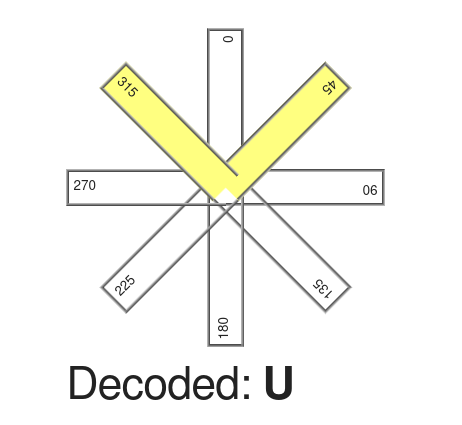

Try it out here: Semaphore Decoder
It worked great and I felt that it was way faster, just like our self-checkout users above. But after a highly-scientific evaluation (decoding four phrases from my friend Johnny), I was surprised to learn the decoder was only equal in speed to the lookup table.
The true value of the semaphore decoder is to offload cognitive effort. Instead of burning mental energy trying to match a shape in a lookup table, I can mechanically use my tool to grind through the rote decoding process - no faster, but still easier.
That means I'm free to focus my efforts on more interesting, fun, and challenging aspects of the puzzle. I keep more energy for the next puzzles in the hunt.
Lighter burdens make your journey feel faster
Via my third and final highly-scientific study (my personal vibes), I've come to believe we fixate on speed and time measures for two reasons:
"Time is money" is a pervasive metaphor in our culture.
It's easy to measure and compare.
But even if a new approach is equally slow or even slower, the value of reducing effort is real.
I've previously written a bit on the history of the command bar/palette seen in apps like VS Code, Notion, and Slack. That’s a UI pattern that is actually slower than dedicated keyboard shortcuts, but it provides a better user experience by providing better discoverability and reducing cognitive load.
The self-checkout is slower, but I can relax a little. The semaphore decoder isn't any faster, but I feel less mentally tired. And the command bar is slower, but I can always find what I was looking for.
Sure, if all things are equal, I prefer faster. Who wouldn’t? But if you only prioritize hard numbers and squeezing out every moment of savings, you are going to miss the opportunity to make your effort lighter - and relax for the same result.
I like the tools that make my work lighter, not just faster.